April 22 marks the 56th year of the international holiday, Earth Day. Founded in 1970 to protest environmental degradation, the holiday has grown into a global movement involving over one billion people. Activities range from planting trees and cleaning outdoor spaces to recycling projects and environmental education events. Yet once April 22 ends, many people leave those attitudes behind for the other 364 days of the year.
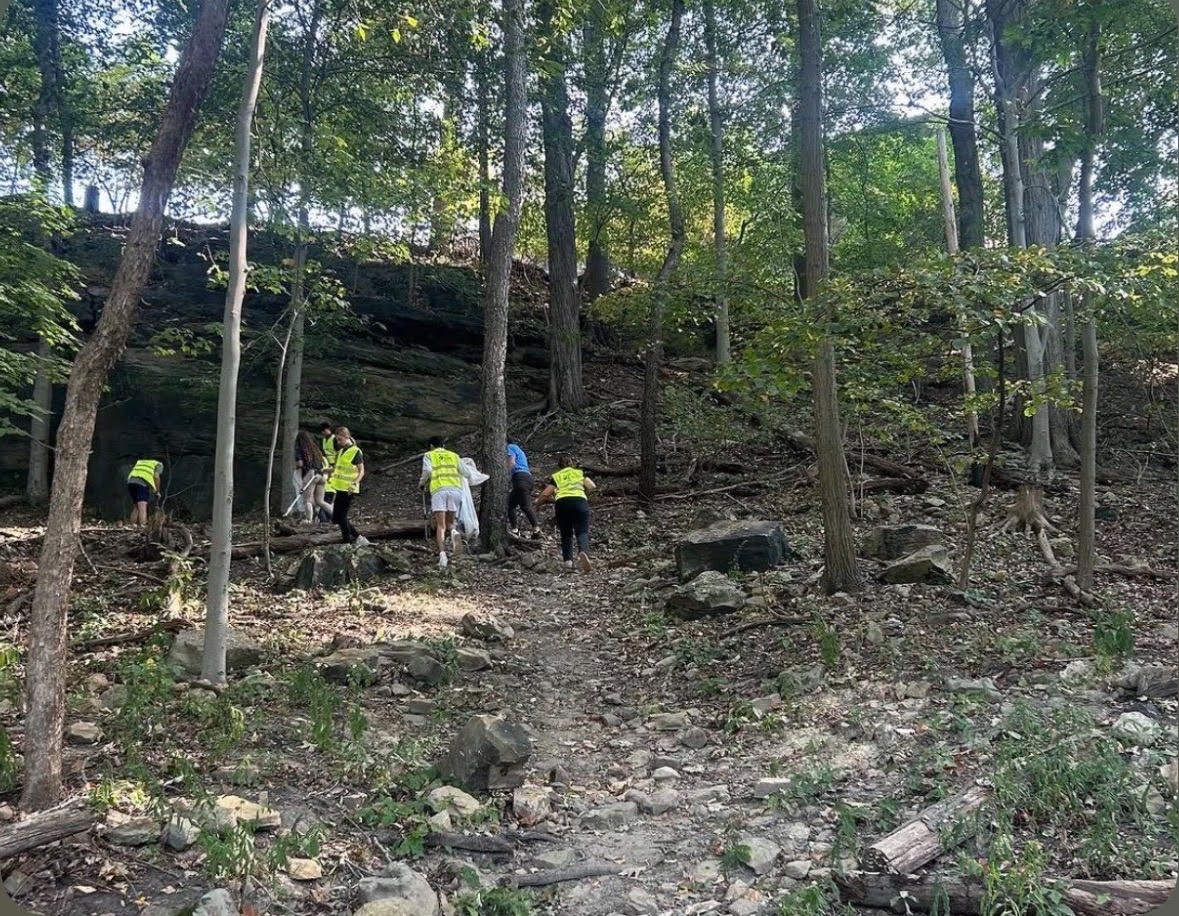
To combat this lack of year-round care, Hoban students and teachers have created resources and opportunities that support sustainability. Hoban senior and leader of the Earth Guardians club, Sascha Paonessa, states that the club’s goal is to “encourage others to have an increased sense of care for the environment.” Paonessa shares that members regularly visit local parks to clean litter. Because the club is currently made up of seniors, this spring is a strong opportunity for juniors to join and continue its mission.
On the administrative side, Associate Principal of Academics and Coordinator of Holy Cross Educator Formation Candace Bates offers insight on sustainable living. As a former biology, environmental science, bioethics and public health teacher at Hoban, she brings experience to the topic.
“Sustainability means that instead of looking at things in a linear path, we can create cyclical systems. An example is recycling” said Bates. “Instead of looking at nature as something to be used, we can coexist with it indefinitely.”
Bates also explains how nature benefits people.
“Spending 15 minutes in nature dramatically improves mood,” Bates said. “How do we protect and conserve natural spaces so someone in 2076 can still have a good outdoor space?”
She advises students to begin realistically, noting that it is “not an us vs. them, environmentalists vs. consumers. We should all have things to eat and safe water.”
Bates also warns that one growing environmental issue is the rapid expansion of Artificial Intelligence. Society often overlooks how much water is required to cool data centers, which could worsen shortages for communities already lacking water.
Fortunately, smaller changes can still matter. One example is balloons.
“Because they [balloons] are flexible, animals can confuse them with food and then starve to death,” Bates said. Also, helium is a non-renewable resource. We use helium for lots of medical processes like MRIs, and since we only have a limited amount of helium, we should save it. We can make other materials that are reusable and can draw attention, using Cricuts and 3D printers, that don’t have the same negative environmental impacts of balloons.”
Hoban has already taken steps toward sustainability. When the school awarded a contract for construction of the maker space, it chose a company that prioritized environmentally friendly practices. During construction, 90% of the energy used came from methane and other gases produced at a landfill. Properly designed landfills can refine organic waste into fuel.
Further steps could still be taken.
“Kenston has wind turbines and it never gets hot there,” Senior Jess Krejsa said. “We could find a nice place to build some at Hoban so that we can sustainably power air conditioning.”
Modern turbines can even be stationary and funnel wind inward.
If changes are not made, the consequences may be severe. Bates warns of an “increase in natural disasters as water levels rise, causing an increase in storms and an increase in infectious diseases as vectors take home in warm climates. A lot of issues about climate migration will emerge; the hottest places on earth can become unlivable, so where will 2 billion people go? Ohio has water and parks, so if climate change continues, we can expect people to come here.”