
Standing as the foundation for Hoban’s mission is the assistance of student excellence, an element that reaches into every inch of the campus. Renovations and landscape alterations are frequently made to enhance efficiency for educational conduct. But as the strive for a perfected campus persists, the loss of vital environmental resources increases in accordance. Concerns regarding the absence of natural foliage around Hoban’s property due to perpetual alterations have become prevalent among students and faculty alike.
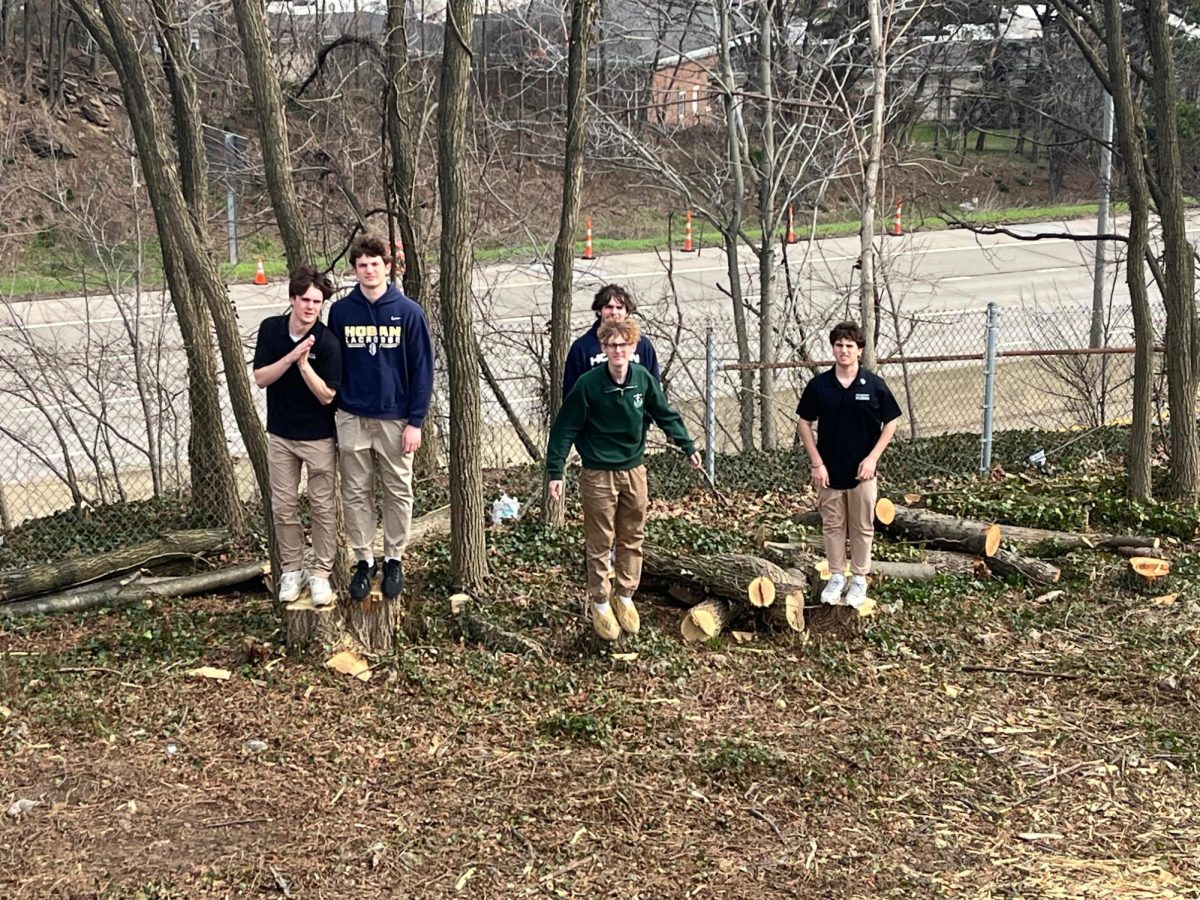
Larger discussion sparked on March 30 after a line of trees on the northeast side of campus was removed, leaving a series of stumps in its place. College Credit Plus (CCP) Environmental Science teacher Anna Siders guided her second period students outdoors to observe the landscape changes and link them with course knowledge on ecosystem changes.
Siders details the slew of consequences that may occur due to the sudden modifications. Loosened soil caused by stump removal increases the likelihood of erosion, drastically altering the structure of the land. Furthermore, the loss of foliage eliminates essential habitats and food sources for local wildlife, diminishing fundamental aspects of the ecosystem. Ground ozone levels also become a matter of concern, as the plants that act as vital elements that purify polluted air have been removed. Altering the environment surrounding the school comes with its consequences, presenting trade-offs for every advancement.
Additionally, some have expressed concerns that such modifications may deeply impact the quality of student experience on campus. Many students prefer conducting class time outdoors due to the open space and peaceful environment. Removing certain elements that may make Hoban’s campus peaceful can hinder student desire to focus on studies. Reducing trees on the campus’s northern border allows noise from nearby roads and buildings to more easily encroach into student spaces, and the reduction of naturally shaded areas lessens student enthusiasm for conducting activities outdoors.
“I think that we should prioritize having greenery around campus,” CCP Environmental Science Student Quinn Slota said.
While unease regarding renovations have been circulating, the understanding that many alterations are made with the intention of improving academic performance and students’ success is frequently acknowledged. Trade offs are required for Hoban’s advancement, and therefore the desire for compromise is central to possible environmental remedies. Pertaining specifically to the situation regarding tree removal on campus, planting saplings in alternative locations provide solutions to the habitat loss and the increase in ground ozone levels.
“Student achievement is priority number one and should continue to be priority number one,” Siders said. “If that means expanding the school, that makes sense, but there is a trade-off. That also means that there is an integrity piece, that if we are going to take down trees, we should be replanting them on our campus or committing to planting them somewhere around the planet.”
These alterations deeply impact numerous aspects of the local ecosystem, including student life. Evaluations of the effects caused by deforestation, even on the smallest of scales, should be prioritized when considering renovations around campus. Excellence lies at the heart of Hoban’s mission, and to maximize excellence a balance of expansion and conservation must be maintained.