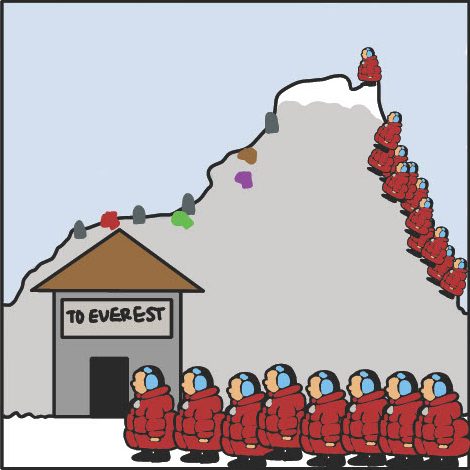
The 2026 Mount Everest climbing season has officially ended, and once again the world watched hundreds of climbers attempt to stand on top of the tallest mountain on Earth. This year’s season was marked by record-breaking crowds and dangerous traffic jams near the summit, creating debates over whether Everest has become too commercialized. On May 20 alone, a record 274 climbers reached the summit from the Nepali side of the mountain, the highest one day total ever recorded.
While the accomplishment may sound inspiring, the season also exposed the growing dangers of overcrowding on Everest. At least five climbers died during the 2026 climbing season. Especially while descending through the mountain’s infamous “Death Zone,” which is an area above 8,000 meters where oxygen levels are dangerously low, overcrowding became a large issue. Images of massive queues near the summit spread quickly online, making Everest appear less like a remote peak and more like a busy highway in the sky.
Environmental concerns also remain a major issue. Crowds on Everest continue to leave behind trash, abandoned equipment, and other waste that damage the mountain’s ecosystem. Everest seems to be turning into a victim of its own popularity, with tourism, competition, and online fame pushing more people to attempt a climb regardless of the risks.
Another controversy surrounding Everest is the price paid before a foot is even placed on the mountain. Typically, people pay around 30,000 dollars for a basic permit, but prices can stretch all the way to 300,000 dollars depending on the level of security one wants while ascending.
There are still some upsides to this great climb. For Nepal, where Everest is located, the tourism of Everest takes up a large amount of the country’s GDP.
Despite the controversies, Everest still represents determination, adventure, and human ambition. Yet the events of the 2026 season show that even the world’s greatest achievements can come with serious consequences when popularity and profit begin to outweigh safety and responsibility.